KNOW WHERE THE CASE IS
When a transfer tightens below forty minutes at Amsterdam Schiphol, Dallas/Fort Worth, or Istanbul Airport, passengers connect before checked bags do. Location hardware inside a suitcase cannot reroute a baggage cart, nor does a map pin compel ground handlers to abandon airside security rules—but accurate telemetry tells you immediately whether to wait at the belt, file a Property Irregularity Report (PIR), or share a verified location link with an airline tracing portal.
HOW SIGNALS BEHAVE INSIDE TERMINALS
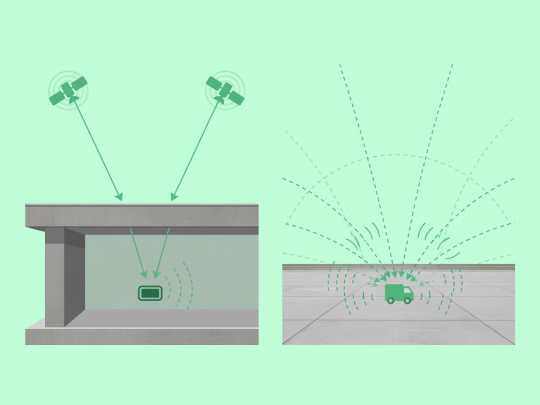
Marketing diagrams show satellites beaming clean lines directly into an aircraft belly. Real airport infrastructure blocks high-frequency signals at almost every stage. Widebody aircraft load bags inside aluminium Unit Load Devices (ULDs) such as LD3 containers, which sit below a metallic cabin floor inside a pressurised fuselage.
In that environment, direct GNSS satellite reception (1.5 GHz L1 band) drops to zero until the container door opens on an outdoor apron. Effective luggage tracking therefore depends on opportunistic relays: brief Bluetooth pings caught by ramp crew phones, Wi-Fi MAC address lookups inside sorting halls, or low-band LTE-M bursts when a tug drives across the tarmac.
Recent software integrations—such as Apple's Share Item Location links accepted by more than fifteen international airline groups including United, Delta, British Airways, Lufthansa, Air Canada, and Qantas—bridge consumer tags with official WorldTracer recovery workflows without handing over personal account credentials.
TECHNOLOGY COMPATIBILITY MATRIX
| Architecture | Power Source | Flight-Mode / Hold Caveats | Subscription Cost | Best Use Case |
|---|---|---|---|---|
| BLE + UWB Tag (Find My / Find My Device) | CR2032 or rechargeable coin cell (8–12 months) | Ultra-low output (~1–4 mW); widely accepted by FAA, EASA, and major carriers in checked bags under micro-cell thresholds. | None | Busy commercial airports, carousel precision finding, airline link sharing. |
| Integrated Cellular GNSS (LTE-M / NB-IoT + Wi-Fi) | 300–1,500 mAh Li-ion (7–21 days per charge) | Must incorporate automatic flight-suppression sensors (accelerometers/barometers) to mute cellular transmission while airborne; check carrier lithium rules if non-removable. | Annual or monthly SIM plan | Remote overland transfers, rail/ferry legs, areas with low smartphone density. |
| Electronic Bag Tag (E-Ink + NFC/BLE) | Battery-free NFC harvest or AAA/button cell | Replaces paper thermal strips only on partner airlines; display stays readable even if power drains completely. | None (hardware purchase) | Frequent domestic or European flyers skipping kiosk print queues on supported carriers. |
TAPED BEHIND LINING RIBS
Inside polycarbonate or polypropylene shells, secure trackers inside a zippered maintenance pocket against the outer wall rather than loose in a shoe bag. Avoid sandwiching the module directly behind telescopic aluminium handle tubes or dense toiletry pouches, both of which absorb 2.4 GHz Bluetooth and 6–8 GHz UWB energy.
SOLVING METAL ATTENUATION
Testing shows closed aluminium suitcases can cut Bluetooth discovery distance from 30 metres down to 2–4 metres. If you travel with metal luggage (see Light Materials), place tags inside reinforced polymer wheel housings, recessed top-handle mounts, or flush composite luggage-tag holders riveted to the exterior recess.
AUTOMATIC AIRBORNE RADIO CUT-OFF
Active cellular luggage trackers certified for aviation (aligned with FAA AC 91.21-1D and RTCA DO-160 standards) combine dual-sensor logic—such as takeoff acceleration profiles and cabin pressure shifts—to shut off cellular modems before climb-out and wake up upon landing rollout.