WHEN LUGGAGE FOLLOWS
Walking 1.4 kilometres between concourses with heavy gear has inspired three distinct breeds of powered luggage: autonomous cases that shadow their owner hands-free, motorised ride-on cabin scooters, and power-assisted handles that neutralise ramp drag. Before buying any bag with an electric motor, weigh three unglamorous realities: unladen tare mass, packing volume lost to motor tunnels, and growing airport terminal prohibitions on rideable luggage.
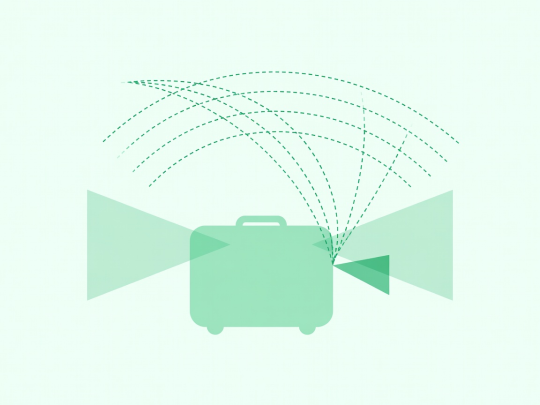
HOW FOLLOWING SENSORS TRACK A TRAVELLER
Autonomous cases (pioneered in commercial models such as Ovis/ForwardX vision designs and UWB-tethered concepts) combine two sensor stacks to avoid clipping bystanders or following the wrong navy coat into a duty-free shop:
Ultra-Wideband (UWB) Time-of-Flight Tethers: A wearable wristband or phone beacon exchanges nanosecond radio pulses with dual antennas in the suitcase chassis, calculating exact distance and bearing angle even if another passenger briefly steps between you and the bag.
Stereoscopic Optical / ToF Obstacle Avoidance: Low-mounted depth cameras scan ahead for luggage trolleys, toddlers, pillars, and floor drop-offs (stairs and escalator thresholds), braking the brushless hub motors automatically and vibrating the owner's wristband when human intervention is needed.
TERRAIN, AIRPORTS AND MUNICIPAL RULES
WHERE RIDE-ON SUITCASES ARE RESTRICTED
Several major airports and transport authorities explicitly prohibit riding motorised suitcases on concourses or public pavements. In Japan, police classify powered ride-on suitcases as motorised mopeds under the Road Traffic Act, making pavement or street riding without plates, mirrors, and insurance illegal; airports including Kansai International and Chubu Centrair ask passengers to walk beside them. Similar concourse riding restrictions operate across major UK and hub terminals. Even where permitted airside, airlines with strict 7 kg or 8 kg cabin scales will require heavy scooter frames (often 8–9.4 kg empty) to be checked after ejecting the battery.
SMALL SOLID WHEELS VS EXPANSION JOINTS
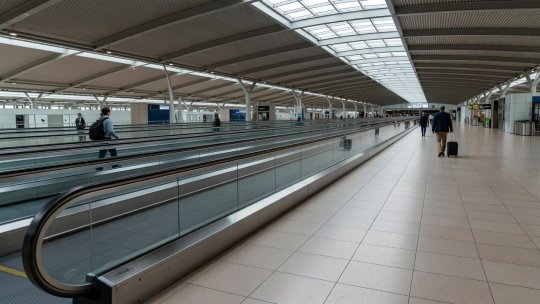
80–100 mm polyurethane drive wheels roll quietly on polished porcelain tile, yet plush terminal carpet (common at Singapore Changi or Portland International) triples rolling resistance and halves battery range. Raised brass expansion joints, tactile paving blisters, and steep jetway thresholds still require retracting the drive wheel and pulling the bag manually.
POWER-ASSIST HANDLES AS THE QUIET ALTERNATIVE
Strain-gauge handles wired to compact wheel hub motors detect forward push or uphill pull tension and supply proportional torque assist while the bag stays firmly in your hand. Because nobody rides the case and nothing rolls untethered, torque-assist bags draw zero attention from terminal safety marshals and assist travellers managing shoulder or wrist strain.
CHECKLIST BEFORE BUYING A MOVING CASE
- Verify true unladen weight with the battery installed against the strictest cabin scale on your regular routes.
- Test freewheel drag: Brushless motors must disengage cleanly so pushing the bag unpowered feels like a standard spinner, not like churning cold molasses.
- Confirm watt-hour stamping: Ensure Wh, voltage, and mAh are permanently laser-marked on the removable battery casing—security screeners routinely confiscate unmarked packs even if under 100 Wh.